Did you know that on the 1st of April, 2026, humans are returning to the moon after 50 years away following the end of the Apollo missions? Do you also know that the mission pilot is a Black man? Yes, I am sure this sounds new to you. Victor Glover is the pilot of the Orion spacecraft taking humans back to the moon.
Humans are indeed returning to the moon on a mission called Artemis II. Artemis II is the first crewed mission in NASA’s Artemis program and marks a major step toward returning humans to the Moon. The mission will send four astronauts aboard the Orion spacecraft on a multi-day journey around the Moon to test critical systems, life support, and navigation in deep space. Artemis II is designed to validate the spacecraft and crew operations, paving the way for future lunar landings and long-term human exploration beyond Earth orbit. This is one of the steps toward the ultimate goal of a mission to Mars. This is huge for humanity and space travel, and I am sure you are asking: humans are going to the moon, so what?
When humans first landed on the moon in 1969, it was a giant leap for humanity. Now, thanks to people like Elon Musk, a South African, the possibility of humans landing on Mars is gradually becoming a reality. Africans have been largely left out of such monumental leaps in humanity, and I believe it should not be so. We must find ways to contribute and be part of the next frontier of space exploration.
Someone reading this will argue that we have many problems: places with no clean drinking water, no internet, no electricity connectivity, and many more. The argument will continue that we should solve these fundamental problems before going to the moon. The truth is that when Africans are given the opportunity to solve certain problems, our frugal approach and our perception, despite numerous hurdles, enable us to find the best solutions. I believe that a platform must be created for young people especially to learn more about such happenings in the world and to arouse their interest in a future in space exploration. It took the world 50 more years before we are now sending a crewed mission back to the moon.
In 2016, I was in Munich for a conference where I met a space entrepreneur and spoke to him about Elon Musk’s ambitious goal of sending humans to Mars. I wrote about it here. It has been ten years since that post, and yet humans have still not gone to Mars, and Africans have still not made any significant progress when it comes to space exploration. Do not get me wrong: there are countries in Africa building satellite stations, but my focus is exploring what lies beyond Earth orbit. There has been some good news, such as Dr. Sara Sabry, a biomedical engineer and entrepreneur who became the first Egyptian, Arab, and African woman to travel to space aboard Blue Origin’s New Shepard rocket (NS-22) in August 2022. We could do more. We do not have any African nation as part of the International Space Station, and we do not have any active program that will send African scientists to space.
Why am I speaking about this? I believe that space exploration is going to play a significant role in this century. Countries are going to colonize planets and celestial bodies, and we in Africa should not take a back seat but be informed and involved. This is exciting, and we must be part of it. Secondly, the kind of innovation, thinking, and planning that goes into this sector is highly motivating and can prove that with determination, leadership, and will, we as Africans can reach for the moon and stars.
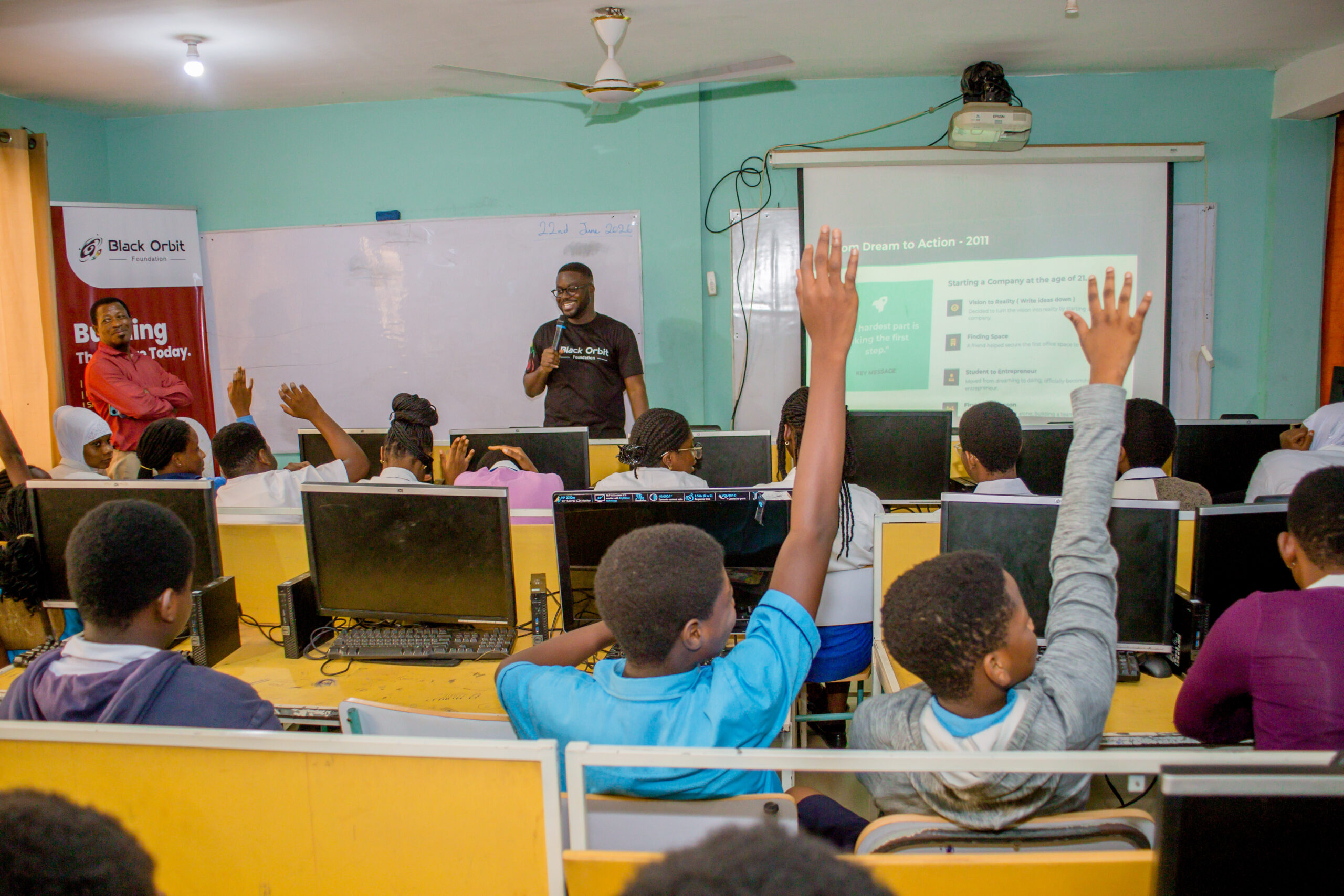
So with that said, humans are going back, and I think you should mark that date, go to the official NASA website and YouTube, and be part of history. I will do my best to raise awareness through my nonprofit Black Orbit Foundation and inspire young people to grow up with the knowledge that they could literally reach for the moon, stars, and Mars.